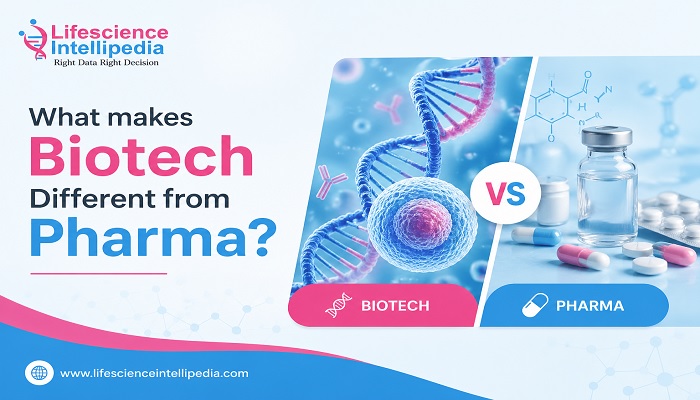
If you’ve ever Googled “biotech vs pharma” and came out more confused than when you started, this is for you.
These two industries get mixed up all the time. Even people who work in life sciences blur the lines. But if you’re making decisions in R&D, investment, or drug development, knowing the difference isn’t optional — it’s essential.
Let’s break it down simply.
What is Pharma?
Pharma companies make drugs using chemistry. They take chemical compounds, combine them in labs, and turn them into pills, capsules, or injections.
Think of drugs like ibuprofen, antibiotics, or statins. Those are pharma products — small, chemically-made molecules that are easy to manufacture and ship worldwide.
Big names in pharma include Pfizer, Johnson & Johnson, and Roche.
What is Biotech?
Biotech (short for biotechnology) companies make drugs using biology — literally living cells, proteins, and genetic material.
Instead of mixing chemicals in a lab, they work with living systems to create treatments. These are called biologics, things like monoclonal antibodies, mRNA vaccines, and gene therapies.
Think of the Moderna COVID-19 vaccine, that’s a biotech product, built on mRNA technology.
Other well-known biotech companies include Genentech and Incyte.
5 Real Differences Between Biotech and Pharma
It’s true that Bioteh and pharma are somewhat related, but most of their core aspects are very different than each other. Here are some major differences between biotech and pharma:
1. The Science Behind the Drug
Pharma is rooted in chemistry. Biotech is rooted in biology.
Pharma scientists design molecules. Biotech scientists engineer living cells or reprogram genetic material. Two completely different skillsets, labs, and tools.
2. What the Drug Actually Is
A pharma drug is a small molecule — simple, stable, and easy to store. You can keep aspirin in a cabinet for years.
A biotech drug is a large, complex molecule. It needs refrigeration, careful handling, and precise delivery. That’s why biologic drugs like Humira come with special storage instructions.
3. How the FDA Reviews Them
Both types of drugs go through clinical trials, but the approval process is different.
- Pharma drugs go through the NDA pathway at FDA’s CDER.
- Biotech drugs go through the BLA pathway at FDA’s CBER.
Biologics face extra scrutiny because small changes in how they’re made can change how they work in the body.
4. The Risk Involved
Biotech is a high-stakes game. Failure rates sit between 70–90%, because a lot of biotech drugs are based on science that’s never been proven in humans before.
Pharma is more conservative. Companies optimize what already works, build on existing drug classes, and scale proven chemistry.
5. Making the Drug at Scale
Pharma manufacturing is like following a very precise recipe — you can run it in factories worldwide with consistent results.
Biotech manufacturing involves growing living cells in carefully controlled environments. It’s expensive, sensitive, and much harder to scale. One contamination event can wipe out an entire batch.
Real Companies, Real Examples
Biotech Companies
Moderna — Built entirely around mRNA technology. Made one of the first COVID-19 vaccines and is now targeting cancer and rare diseases with the same platform.
Incyte — Focuses on oncology. Uses genomics to build targeted cancer treatments.
Genentech — One of the original biotech companies, now part of Roche. Known for monoclonal antibodies and cancer therapies.
Pharma Companies
Pfizer — A traditional pharma giant known for blockbuster drugs like Lipitor. Also partnered with BioNTech to co-develop a COVID-19 mRNA vaccine.
Johnson & Johnson — Covers pharma, medical devices, and consumer health. A massive, diversified operation.
Roche — Started as a pharma company, now deeply invested in biotech, diagnostics, and personalized medicine.
Is the Line Between Biotech and Pharma Disappearing?
Kind of, yes. Large pharma companies are acquiring biotech firms at record pace. Pfizer partnered with BioNTech. Roche bought Genentech. The lines between the two are getting blurry.
But the underlying difference, chemistry vs biology, still defines how drugs are discovered, made, and approved.
The Bottom Line
Both industries are working toward the same goal: better treatments for patients. But they get there using completely different tools, timelines, and risk levels.
Whether you’re investing, researching, or building a career in life sciences — knowing which world you’re playing in changes everything.
FAQs
Q1: Can a company be both a biotech and a pharma company?
Yes, and it’s becoming more common. Companies like Roche and Pfizer started as traditional pharma giants but have heavily invested in biotech through acquisitions and partnerships. When a company works across both chemical drugs and biologics, they’re often called a “biopharma” company.
Q2: Are biotech drugs always more effective than pharma drugs?
Not necessarily. Effectiveness depends on the disease, the patient, and the specific drug — not whether it came from a lab using biology or chemistry. Biotech drugs tend to be more targeted (especially in cancer treatment), but pharma drugs like antibiotics and painkillers remain some of the most effective and widely used medicines in the world.
Q3: Why are biotech drugs so much more expensive than pharma drugs?
Because they’re incredibly complex and costly to make. Biotech drugs are grown inside living cells under tightly controlled conditions — one small error can ruin an entire production batch. The R&D process is also longer and riskier, and those costs get passed down to patients and insurers.
Q4: What does “biologics” actually mean?
A biologic is any drug that comes from a living source — a cell, protein, or piece of genetic material. Examples include insulin, monoclonal antibodies like Humira, and mRNA vaccines like Moderna’s COVID-19 shot. If the drug was made using biology rather than chemistry, it’s a biologic.
Q5: What is a biosimilar, and how is it different from a generic drug?
A generic drug is a chemical copy of a pharma drug — identical in every way, since small molecules are easy to replicate exactly. A biosimilar is the biotech equivalent, but it’s not a perfect copy. Because biologics are made from living cells, you can get close but never exact. That’s why biosimilars go through a separate, more rigorous approval process compared to generics.