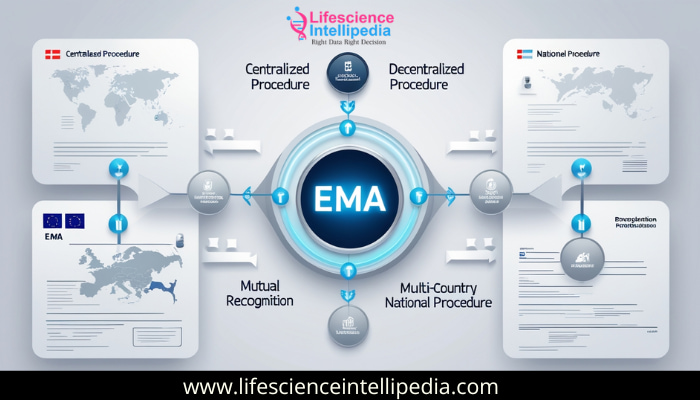
Europe is one of the strictest pharma markets, but also one of the best places to launch a new drug. Companies love the market size, but they also know the rules here can feel… well, a bit confusing.
In Europe, drug approval does not happen through just one office. You have EMA, you have national authorities, and you even have multi-country routes that mix everything together. So if you’re a company trying to enter the EU, it’s easy to ask, “Which pathway do I even use?” Don’t worry, this blog keeps it super simple.
In this post, we give a clear overview of the main marketing authorization pathways in Europe, when to use them, and why they matter. Whether you are planning a small local launch or a full EU-wide approval, you’ll understand the basics without drowning in regulatory jargon.
What Is Marketing Authorization in Europe?
Marketing Authorization (MA) in Europe is basically the official permission a company needs before selling a medicine in the region. Without this approval, no drug can enter the market, simple as that. It’s the EU’s way of making sure every medicine is safe, effective, and high quality before patients ever use it.
Centralized Procedure (CP)
Instead of running around different countries, you file one application to the European Medicines Agency (EMA) and once it gets approved there, it’s automatically approved in all EU member states at once.
This pathway is mandatory for certain product types—especially the high-tech stuff. If you’re dealing with biologics, orphan drugs, advanced therapy medicinal products (ATMPs), cancer medicines, or new biotech products, you pretty much have no choice. The EU wants these handled under one roof.
Advantages of the Centralized Procedure
- Single Dossier: You don’t prepare 27 versions of your application. Just one.
- One Scientific Assessment: EMA’s experts handle the review and issue one opinion.
- EU-Wide Coverage: Approval applies to all EU countries automatically.
- Consistent Labeling: Same product information everywhere—no messy variations.
- Strong Prestige: EMA approval boosts credibility globally.
Who Should Use the Centralized Procedure?
- Innovative pharma companies launching new, cutting-edge products
- Biotech firms with monoclonal antibodies, recombinant proteins, or ATMPs
- Companies with orphan drugs targeting rare diseases
- Oncology developers needing EU-wide access fast
- Any team that wants a single, clean regulatory pathway without juggling multiple national agencies
Decentralized Procedure (DCP)
The Decentralized Procedure is basically for medicines that are not approved anywhere in Europe yet, but you still want to launch them in several countries at the same time. It’s like doing a group project with a “main leader” and a bunch of “team members.”
Here’s a simple explanation of what happens under DCP:
- You pick one country to be the Reference Member State (RMS). This country does most of the scientific review.
- Then you choose other countries as Concerned Member States (CMS). They look at the RMS assessment and decide if they agree.
This whole setup makes DCP perfect for medicines that are not brand-new inventions, but still need multi-country approval. Think generics, well-known active ingredients, or older drugs that need fresh approvals in the EU.
Mutual Recognition Procedure (MRP)
The Mutual Recognition Procedure is basically the “copy-paste” route for Europe. You use it when your medicine is already approved in at least one EU country, and now you want other countries to accept that approval instead of starting from scratch.
Here’s the simple breakdown:
- You must already have a Marketing Authorization (MA) in one EU Member State.
This country becomes the Reference Member State (RMS). - Other countries you want to enter become Concerned Member States (CMS).
They look at the RMS approval and basically say, “Okay, we agree,” unless they find serious concerns.
This makes MRP a super practical route when your product is not new, not complicated, and already has a clean approval history.
What MRP is best for?
- Generic medicines that already proved their bioequivalence
- OTC products (simple formulations, low risk)
- Well-established active substances with a long safety record
- Companies expanding from one EU market to many, quickly and cheaply
In short: MRP = one country approves first → others follow. Fast, simple, and great for scaling established products across Europe.
National Procedure
The National Procedure is the most straightforward of all the European routes. You use it when you want to sell your medicine in just one country and nowhere else (at least for now). No cross-country coordination, no multi-state reviews—just one national authority handling everything. This pathway is useful when your strategy is small, local, or still testing the market.
When to use it?
- Single-country launches where you don’t need EU-wide access
- Simple products that don’t require EMA involvement
- Local sales strategies, such as focusing on one strong market first
How Major EU Markets Differ?
Each country has its own rules, timelines, and quirks (yes, it gets annoying):
- Germany – Fast reviews, very structured, strong generic market
- France – More paperwork, heavy pricing controls
- Spain – Slower timelines, but predictable once you understand the system
- Italy – Additional administrative layers and price negotiations
So even though it’s “national,” each country plays by its own playbook.
Who This Route Works Well For
- Companies testing demand in one market before scaling up
- Firms with localized branding or distribution plans
- Products that are not eligible or not ready for DCP, MRP, or CP
In short: National Procedure = simple, single-country approval without the EU-wide headache.
How Lifescience Intellipedia Helps Companies in EU Authorization?
Getting EU marketing authorization can feel confusing, but we make it simple. Lifescience Intellipedia helps you pick the right pathway, prepare clean dossiers, and move through approvals without delays.
Smart RMS Selection
We help you choose an RMS that is fast, cooperative, and experienced with your product type, making the DCP/MRP process smoother.
Strong, Fixed Dossiers
Our team checks your documents through a full gap analysis and helps you fix:
- Country-specific Module 1
- Quality and safety sections
- Forms and product information
This reduces objections and speeds up approval.
Full DCP/MRP Support
We manage the entire process, including:
- Application preparation
- Handling RMS/CMS questions
- Coordinating responses and timelines
You don’t deal with the regulatory chaos, we do.


