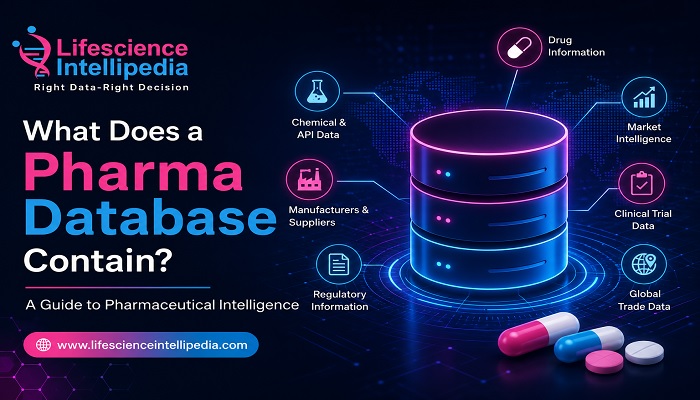
Pharma databases are often associated by people with huge libraries of information containing drug names, company names, and product information.
This may be only one aspect of what the database holds.
Pharmaceutical databases with proper structure could include information regarding products, manufacturers, suppliers, companies, regulations, patents, drug development, competition, and markets. However, all the value of such database is not just the storage of this information.
The value lies in helping people connect it.
For a pharmaceutical company, one simple question can require information from several different areas.
- Who manufactures this API?
- Which are the firms competing for this product?
- Is the product registered in a specific market?
- Are there any issues related to patents or exclusivity?
- What is the competitive environment like?
- Is the market growing?
This is why pharma database services have become increasingly important for pharmaceutical manufacturers, API companies, sourcing teams, business development professionals, and strategy teams.
A pharma database is not just a collection of records.
When used properly, it can become an important foundation for pharma market intelligence.
A Pharma Database Is More Than a List of Products
At its most basic level, a pharmaceutical database organizes information.
But the type and depth of information can vary significantly depending on the database.
A useful pharma database may contain information about:
- Pharmaceutical products
- Active pharmaceutical ingredients
- Manufacturers
- Suppliers
- Company profiles
- Regulatory approvals
- Patents and exclusivity
- Clinical trials
- Competitors
- Market activity
- Industry developments
The most significant factor here is the connection between the different information bits.
For instance, it is vital to know the name of the medicine.
However, it becomes really useful when one can also comprehend:
- Its active ingredient
- Who manufactures it
- Which companies market similar products
- Its regulatory status
- Related patents or exclusivities
- Its therapeutic category
- Potential market activity
This is where a database begins to move beyond simple information storage.
Product Data: Where Many Pharma Searches Begin
Many times, the product itself forms the basis of the initial stage of research for many pharmaceutical professionals.
The need for information regarding the compound, the formulation, the dosage form, or the drug class may arise.
The information regarding the product would be useful in answering the following queries:
- What is the active component?
- What dosage forms exist?
- Who manufactures this product?
- Which is its therapeutic class?
- What similar products exist?
Official pharmaceutical databases demonstrate how detailed product-level information can become. This includes the FDA’s Orange Book, which enables the search of approved drug products based on the active ingredient, proprietary name, applicant, application number, dosage form, route of administration, and patent number.
Some of the ways that product information can benefit pharmaceutical firms include:
- Product selection
- Portfolio analysis
- Competitive research
- Market entry studies
- Business development
But product data alone rarely provides the complete answer.
That is why the information connected to the product matters just as much.
Manufacturer and Supplier Information: Understanding Who Is Behind the Product
Imagine you identify an attractive pharmaceutical product opportunity.
The next question may be:
Who can manufacture it?
For API companies, pharmaceutical manufacturers, and sourcing teams, manufacturer and supplier intelligence can be extremely important.
A database may help identify:
- Manufacturers associated with a product or API
- Geographic locations
- Product portfolios
- Related suppliers
- Manufacturing capabilities
- Company information
- Alternative sources
This information can help a business begin evaluating the supply landscape.
But there is one vital difference to be made.
The database intelligence can help discover the suppliers and do market research, but it must not take the place of supplier qualification, quality audit, due diligence, and contract analysis.
The database helps companies identify where to investigate.
The company’s formal processes determine whether a supplier is suitable.
That distinction is important when discussing the role of pharma database services.
Company Intelligence: More Than a Name and an Address
A basic company directory tells you that a company exists.
A more advanced pharmaceutical intelligence database can provide a broader picture.
Depending on the source, company intelligence may include information about:
- Business activities
- Product portfolios
- Manufacturing locations
- Group companies
- Subsidiaries
- Competitors
- Regulatory activity
- Pipeline developments
- Industry announcements
Why does this matter?
Because pharmaceutical companies rarely operate in isolation.
A company that appears to be a potential supplier today may become a competitor tomorrow.
A competitor may also be a licensing partner.
A company entering one therapeutic area may signal a broader strategic shift.
This is why company information becomes particularly useful for business development and competitive analysis.
The question is no longer simply:
Who is this company?
It becomes:
What is this company doing, and why does it matter to our business?
That shift is an important part of pharmaceutical market intelligence.
Regulatory Data Can Change the Entire Market Picture
Regulatory information is one of the most important categories within pharmaceutical intelligence. The FDA has various drug databases including those on drug shortages, approved drugs, drug guidances for each product, Orange Book, NDC Directory, among others.
This is a good demonstration of a fact about drug data.
No single piece of information tells the complete story.
A company may look at a product and see a commercial opportunity.
But regulatory information may reveal considerations that affect the timing or feasibility of entering that market.
That is why regulatory intelligence should be viewed as part of business intelligence, not as information relevant only to regulatory teams.
Patent and Exclusivity Information: Looking Beyond the Product
For companies evaluating generic or competitive opportunities, patent and exclusivity information can be highly relevant.
A product may have strong demand and attractive market potential.
But the key question may be:
When can meaningful competition actually enter the market?
The FDA’s Orange Book combines information about approved drug products with related patent and exclusivity information.
This information can help companies begin understanding:
- Product protection
- Exclusivity periods
- Competitive timing
- Potential generic opportunities
However, patent information from a database should not be treated as a substitute for a formal legal opinion or freedom-to-operate analysis.
Databases provide information.
Specialized legal and patent analysis determines the implications for a particular business situation.
Again, the value of the database is that it helps companies identify the right questions.
Clinical Trial Information: Understanding What May Come Next
A pharma database is not always focused only on products currently available in the market.
Clinical trial information can provide an early view of what companies are developing.
Depending on the database, clinical intelligence may include:
- Molecules
- Sponsors
- Therapeutic areas
- Development phases
- Trial locations
- Study status
This information can help companies monitor:
- Emerging competitors
- Research activity
- Therapeutic trends
- Pipeline development
- Potential future market changes
But clinical trial activity should be interpreted carefully.
A clinical trial is a market signal.
It is not a guarantee that the product will receive approval or become commercially successful.
This is where context becomes essential.
A strong pharma market intelligence strategy looks at clinical activity alongside regulatory, competitive, and commercial information.
Market Data: Turning Records Into Business Context
A database can tell you what products or companies exist.
Market intelligence helps explain whether an opportunity is commercially meaningful.
Market information may include:
- Market size
- Market volume
- Growth trends
- Geographic activity
- Pricing information
- Competitive conditions
- Demand patterns
But market numbers should never be read in isolation.
For example, a market may be growing rapidly.
That sounds positive.
- But why is it growing?
- Is demand increasing?
- Are prices rising?
- Has a new product entered the market?
- Are more patients being diagnosed?
- Are there changes in treatment practices?
The number alone does not provide the answer.
This is why pharmaceutical market intelligence is more than collecting market statistics.
It is about understanding what the statistics mean.
The Real Value Is in Connecting the Data
This may be the most important thing inside a pharma database.
- The individual records matter.
- But the relationships between them often matter more.
- Imagine a company is evaluating a particular API.
It may want to know:
- Which finished products use this API?
- Who manufactures the API?
- Who manufactures related finished formulations?
- Which markets are commercially active?
- Are new competitors entering?
- Are there regulatory developments?
- Is clinical activity increasing?
Looking at each question separately may require hours or days of research.
A well-organized database can make it easier to connect these information points.
This is where a database starts supporting real pharma market intelligence.
The goal is not to collect information for the sake of collecting it.
The goal is to reduce the time required to understand a business situation.
The Difference Between Data and Intelligence
This difference is simple but important.
Data
There are 40 manufacturers associated with a particular product category.
Information
Out of these twenty manufacturers, twenty of them exist in the regions which matter to your business.
Intelligence
Five manufacturers are highly relevant to your organization based on various factors.
Decision
Your sourcing or business development team decides which companies deserve further evaluation.
The database provides the foundation.
Analysis creates intelligence.
Intelligence supports decisions.
This is why the best pharma database services should not be judged only by the number of records they contain.
The more important question is:
Can the data help us answer a real business question?
What Should You Look for in a Pharma Database Provider?
Choosing a pharma database provider should involve more than comparing database sizes.
A larger database is not automatically a better database.
Here are some important factors to consider.
Relevant Data Coverage
Does the database cover the products, companies, markets, or geographies relevant to your business?
Data Quality
Is the information structured and consistently maintained?
Update Frequency
Pharmaceutical market is continually changing.
Information about regulations, products, and companies may become obsolete.
For example, the FDA’s NDC Directory is updated daily, showing the importance of understanding how frequently pharmaceutical data can change.
Search and Usability
Can users quickly find the information they need?
A database with excellent data but poor usability may still waste significant time.
Source Transparency
Can users understand where important information comes from?
FDA also states that listing in the NDC Directory does not automatically imply the FDA’s verification of the data submitted, as well as the fact that listed products are FDA-approved.
This is something worth bearing in mind by anyone working with pharmaceutical databases:
Always understand what the data represents
Business Relevance
Can the database support the decisions your teams actually make?
Different teams require different intelligence.
How Different Teams Use Pharma Databases
A pharmaceutical database can support multiple business functions.
Sourcing Teams
They may search for:
- API manufacturers
- Alternative suppliers
- Manufacturer information
- Product portfolios
Business Development Teams
They may investigate:
- Companies
- Products
- Markets
- Potential partners
- Competitors
Strategy Teams
They may analyze:
- Market activity
- Competitive developments
- Product trends
- Industry changes
Regulatory Teams
They may use relevant product and regulatory information to support research and planning.
Market Research Teams
They may combine database intelligence with primary and secondary research.
The same database can therefore serve different purposes depending on the business question.
Why Is Data Quality More Important than Data Quantity?
It is easy to get awed by a database which boasts of having millions of records.
But data quantity does not make any difference by itself.
Imagine having millions of records that are:
- Outdated
- Duplicated
- Incomplete
- Difficult to search
- Poorly categorized
That database may create more problems than it solves.
A smaller, well-maintained database may be much more useful.
Good pharmaceutical data should ideally be:
- Relevant
- Structured
- Searchable
- Current
- Consistent
- Contextual
The best decision-makers do not simply ask:
How much data do we have?
They ask:
Can we trust it, understand it, and use it?
How Lifescience Intellipedia Approaches Pharma Database Intelligence
In Lifescience Intellipedia, database intelligence can be seen to have relevance to a bigger business need of helping life sciences firms find information and transform it to intelligence.
Some of the services offered by the firm include pharmaceutical market intelligence, database intelligence, market research, clinical trial intelligence, regulatory consulting, and analytics.
These databases include Chemxpert ecosystem and others that are oriented towards areas relevant to pharmaceuticals and life sciences firms such as product intelligence, company intelligence, market intelligence, and industry intelligence.
This approach is particularly relevant to:
- Pharmaceutical manufacturers
- API companies
- Biotech organizations
- Specialty chemical companies
- Sourcing teams
- Regulatory professionals
- Business development teams
- Strategy professionals
The goal is not simply to provide more data.
It is to make relevant information easier to find and use.
Conclusion
So, what is really inside a pharma database?
The answer is much more than product names and company records.
It can include information about products, APIs, manufacturers, suppliers, companies, regulatory activity, patents, clinical development, competitors, and markets.
But the most valuable part is what happens when those pieces are connected.
A product becomes more meaningful when you know who manufactures it.
A manufacturer becomes more relevant when you understand its portfolio.
A market opportunity becomes clearer when you consider competition and regulatory conditions.
A competitor’s clinical activity becomes more meaningful when you understand the market it could enter.
Frequently Asked Questions
What is a pharma database?
A pharma database is a structured source of information that may include pharmaceutical products, APIs, manufacturers, suppliers, companies, regulatory information, clinical trials, patents, markets, and competitive activity.
What are pharma database services?
Pharma database services provide organized pharmaceutical information that can support sourcing, market research, business development, competitive intelligence, and strategic decision-making.
What is the difference between a pharma database and pharma market intelligence?
A database provides information and records. Pharma market intelligence involves analyzing and interpreting that information to understand market conditions and support business decisions.
How do I choose a pharma database provider?
When selecting a pharma database provider, consider data coverage, quality, update frequency, search capabilities, source transparency, geographic relevance, and how well the database supports your business needs.
Why is pharmaceutical market intelligence important?
Pharmaceutical market intelligence helps companies understand products, markets, competitors, suppliers, and industry developments so they can make better-informed strategic decisions.